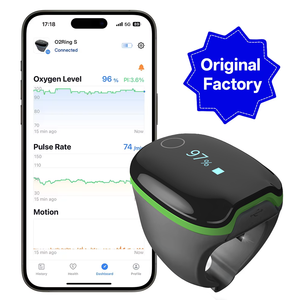
Biometric Sensor
Wellue O2ringS Overnight Pulse Oximeter
SpO2 Tracking
Haptic Vibration
Bluetooth Low Energy
View Product Architecture
Explore production-ready CE, FCC, and RoHS-compliant hardware platforms. Each base architecture supports deep firmware layer customization, custom SDK integration, private-label branding, and rapid prototyping.
Enterprise sourcing teams face unprecedented complexity when evaluating AI-integrated eyewear. The intersection of radio-frequency compliance, optical micro-displays, acoustic privacy, and cloud/edge inference demands rigorous vendor auditing.
Unlike standard Bluetooth audio glasses, AI translation eyewear operates high-duty-cycle duplex data uplinks. Compliance requires conformity with the EU Radio Equipment Directive (RED 2014/53/EU), EN 62479/EN 50663 Specific Absorption Rate (SAR) limits near the temporal lobe, and EN 301 489 electro-magnetic compatibility.
Real-time bidirectional speech interpretation fails if acoustic capture-to-ear latency exceeds 450 ms. Qualified suppliers employ dual or quad MEMS microphone arrays with adaptive digital signal processor (DSP) spatial filtering, mitigating ambient noise via inverse phase cancellation up to 45 dB.
For Heads-Up Display (HUD) translation glasses, optical engine selection governs eye fatigue. Diffractive surface relief gratings (SRG) etched into high-index optical resin provide over 85% ambient light transmittance, projecting translated text strings without obscuring the user's focal visual corridor.
B2B procurement criteria mapped across core computational tiers in optical and audio AI smart frames.
| Engineering Attribute | Tethered Cloud-Inference Eyewear | Hybrid Edge-NPU Translation Glasses | Autonomous Standalone (Cellular/eSIM) |
|---|---|---|---|
| Processing Engine | Nordic nRF5340 / BES2700 Bluetooth SoC | Qualcomm Snapdragon AR1 Gen 1 + On-Chip NPU | MediaTek Helio Series / Embedded 4G LTE Baseband |
| Linguistic Latency | 380 ms – 700 ms (Network dependent) | 120 ms – 220 ms (Local offline vocabulary) | 450 ms – 850 ms (Direct WAN connection) |
| Power Envelope | 110 mAh Li-Po · 8 to 14 hrs Standby | 180–220 mAh Dual-Cell · 4 to 6 hrs Active | 350 mAh Solid-State · 2.5 to 4 hrs Active |
| Thermal Dissipation | < 31.5°C Temporal Hinge Dissipation | < 37.0°C Passive Graphene Bridge Spread | < 39.8°C Regulated Heat Sinks (High Mass) |
| CE/FCC Certification Path | Simplified RED + EMC Class B Standards | Modular Certification + Multi-Band RF Exposure | Full PTCRB, RED, GCF, SAR Head-Exposure Protocol |
B2B brands, telecommunication operators, and defense/industrial procurement departments are redefining baseline specifications across five pivotal vectors.
Translation hardware is migrating beyond simple Speech-to-Text (STT) and Text-to-Speech (TTS) pipelines. Contemporary smart eyewear incorporates vision-language models (VLMs) fed by ultra-compact CMOS sensors, parsing foreign physical street signs, technical manuals, and menus concurrently with audio streams.
Privacy concerns in cross-language business meetings have accelerated the development of reverse acoustic phase cancelling chambers. Sound waves radiating outward from open-ear micro-speakers are neutralized by outward-facing cancellation ports, maintaining privacy past 0.5 meters.
Total frame mass is the deciding factor in consumer retention. Modern manufacturing couples Grilamid TR90 lightweight front assemblies with grade-5 titanium spring hinges, containing the entire battery, antenna array, and logic board under 38 grams total mass for all-day ergonomic equilibrium.
Since 2008, Shenzhen Tucks Technology Co., Ltd. has delivered precision wearable technology from our certified manufacturing center in Nanshan District, Shenzhen. We provide a complete manufacturing bridge from initial industrial design to finished retail delivery.
Operating high-precision Yamaha and Panasonic pick-and-place surface-mount machinery capable of mounting ultra-dense 01005 passives and multi-layer rigid-flex PCB assemblies without component warping or solder voiding.
Every lot undergoes 100% optical inspection (AOI), Bluetooth antenna radio spectrum testing in anechoic chambers, battery cycling aging protocols, and IP68 hermetic pressure decay testing prior to final assembly validation.
From custom CNC tooling and magnesium alloy casting to bespoke firmware language packs, companion iOS/Android app white-label development, and API access, we eliminate third-party software middleman dependencies.
Clear technical, logistical, and compliance guidance for cross-border sourcing managers and product owners.
End-to-end latency is the sum of four discrete hardware and transmission stages: Acoustic capture & DSP Beamforming (20–40 ms), Bluetooth BLE/A2DP buffer streaming to mobile device (40–80 ms), Cloud Neural Machine Translation (150–250 ms over 5G/Wi-Fi), and Text-to-Speech audio synthesization stream return (60–100 ms). Total round-trip latency remains consistently under 450 ms under enterprise networks.
Full CE Declaration of Conformity (DoC) portfolios include complete technical test files under the Radio Equipment Directive (2014/53/EU), EN 300 328 (Wideband transmission systems 2.4 GHz ISM), EN 301 489-1/-17 (EMC for radio equipment), EN 62368-1 (Product Safety for Audio/Video and ICT), and EN 50566 (Head SAR testing demonstrating compliance with the 2.0 W/kg 10g tissue limitation).
Standard white-label OEM execution (laser temple logos, bespoke packaging enclosures, customized Bluetooth broadcast strings, and unique initial boot chime) begins at a flexible 200 pieces per order. Complete ODM bespoke structural injection tooling or custom PCB flex profiling usually requires an initial volume commitment of 2,000 to 5,000 pieces depending on casing geometry.
Our application layer interfaces natively with top-tier multi-engine translation infrastructures (including Whisper, DeepL, Google Cloud Neural, and OpenAI APIs). Enterprise B2B purchasers can connect private glossary keys or fine-tuned LLM translation endpoints through our open companion Android/iOS application SDK, providing over 98% linguistic accuracy across localized terminologies.
Partner directly with Shenzhen Tucks Technology. Obtain complete schematics, functional white-label sample units within 7 business days, and comprehensive B2B supply agreements with transparent lead times.