Featured Smart Rings & Wearable ODM Hardware Solutions
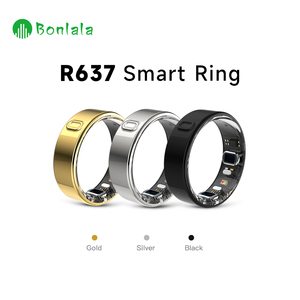
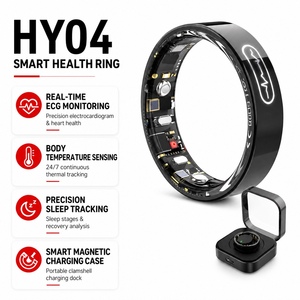
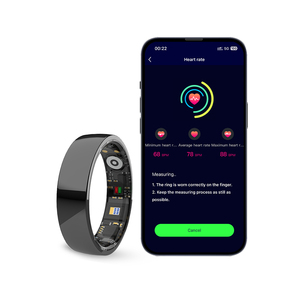
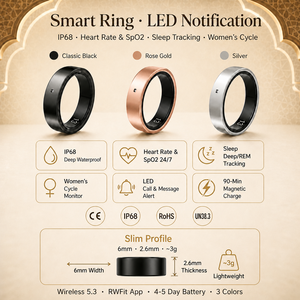
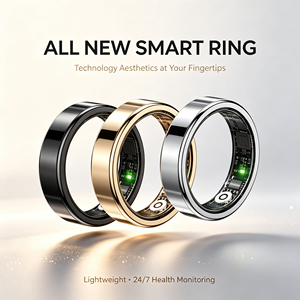
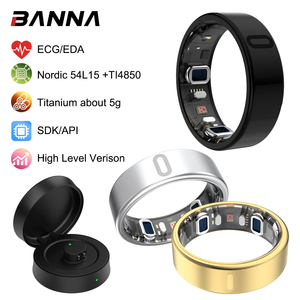
Engineered for global tech brands, medical device integrators, and premium wellness labels. Featuring high-precision photoplethysmography (PPG), dual-wavelength SpO2, skin-contact EDA sensors, micro-ECG leads, and low-power Nordic nRF5340 Bluetooth LE 5.3 chipsets.
Institutional Wearable Manufacturing Infrastructure
Headquartered in Shenzhen's high-tech manufacturing corridor, Shenzhen Tucks Technology Co., Ltd. operates state-of-the-art SMT lines, automated micro-dispensing epoxy robots, and complete RF darkroom test chambers for global enterprise buyers.
Sub-Micron Packaging & Multi-Sensor Fusion
Achieving clinical reliability inside an ultra-compact ring shell (sub-2.6mm cross-sectional thickness) requires high-density 8-layer rigid-flex PCB substrates with buried and blind micro-vias. We utilize System-in-Package (SiP) modules coupled with custom curved lithium polymer pouch cells, maximizing active battery chemistry density up to 480 Wh/L.
Our optoelectronic sensor paths integrate green (525nm), red (660nm), and infrared (940nm) emitters aligned with dual-channel photodiode arrays. This multi-spectral approach delivers high signal-to-noise ratios (SNR > 95dB) even across diverse skin tones and cold ambient perfusion states.
Edge-Computing Algorithms & Micro-ECG Channels
Unlike legacy fitness trackers that transmit raw continuous data streams—depleting sub-20mAh batteries in hours—our ODM firmware runs ultra-low-power local DSP heuristics directly on the Nordic nRF5340 dual-core ARM Cortex-M33 application processor. Pulse Wave Analysis (PWA) and Heart Rate Variability (HRV) feature extraction occur on-chip.
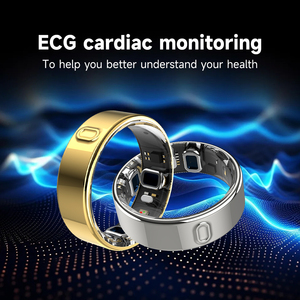
Single-lead ECG registration uses proprietary medical-grade 316L stainless steel or titanium dry electrodes embedded into the interior and exterior ring surfaces. Touching the external contact with the contralateral index finger closes the Einthoven loop, acquiring instantaneous diagnostic Lead-I electrocardiograms filtered against 50/60Hz electromagnetic line noise.
Hydrophobic Encapsulation & IP68 / 5ATM Validation
Hermetic integrity is the primary point of failure for consumer smart rings. As an established China smart wearable ODM supplier, we replace mechanical screws and gaskets with continuous liquid resin transfer molding (RTM) and biocompatible epoxy underfill. The outer chassis is milled from Grade 5 Titanium (Ti-6Al-4V) or medical zirconia ceramics.
Every batch undergoes rigorous quality-control cycling: 100% individual vacuum leak testing, 50-meter hydrostatic hyperbaric holding chambers for 60 minutes (5ATM), and corrosive artificial sweat immersion tests for 96 hours, meeting CE, FCC, RoHS, and FDA skin-contact biocompatibility standards (ISO 10993).
B2B Smart Wearable Architectural Benchmarks
Detailed technical specifications comparing baseline OEM consumer fitness rings versus Tucks industrial-grade ODM micro-wearable platforms.
| Evaluation Parameter | Standard Low-Cost Ring (Trading Units) | Tucks Enterprise ODM Architecture | Procurement Advantage |
|---|---|---|---|
| Core Microcontroller (MCU) | Generic 32-bit RISC / Low-tier BLE SoC | Nordic Semiconductor nRF5340 / Realtek Dual-Core | Zero dropped BLE packets, dual-core security partition |
| Biometric PPG Architecture | Single-Green diode, high ambient light leakage | Multi-Wavelength (Green + Red + Dual-IR) + Dual PDs | Accurate peripheral SpO2, HRV root-mean-square (RMSSD) |
| ECG & Electrodermal (EDA) | Absent / Optical simulation only | Dual Titanium Electrodes + Galvanic Skin Resistance IC | Real physical bio-potential signals; medical app readiness |
| Chassis Construction | Plated zinc alloy or resin composite | Grade 5 Titanium (Ti-6Al-4V) & Biocompatible Ceramic | Hypoallergenic, ultra-lightweight (sub-3g), scratch-proof |
| Hydrostatic Pressure Rating | IPX4 - IPX7 (Splashes only, joint leaks) | Solid Epoxy Void-Free Injection (5ATM / IP69K) | Continuous swimming, sauna, shower, and sports endurance |
| Battery Cell Chemistry | Standard pouch cell, 300 cycles to 70% | High-Density LCO Pouch, 800+ cycles to 80% residual | Extends end-user product operational lifespan to 3+ years |
| Firmware, App & Cloud SDK | Generic public server, unbranded APK | Turnkey iOS/Android SDK, private AWS cloud, HIPAA/GDPR | Direct brand IP ownership, enterprise database compliance |
Global Smart Wearable Procurement Trends (2025–2030)
For procurement directors, hardware product managers, and technology importers: strategic guidance on navigating supply chain consolidation, sensor miniaturization, and evolving regulatory mandates.
1. Decentralization from Wrist to Finger Micro-Form Factors
The global smart wearable landscape is experiencing a massive paradigm shift. While smartwatches retain dominance in interactive communications and navigation, smart rings have established clear superiority in continuous, non-intrusive health tracking. The palmar digital arteries provide significantly higher blood vessel density and thinner epidermis layers compared to the dorsal wrist, translating into higher PPG signal amplitude with one-third the LED power output.
Enterprise procurement channels are rapidly allocating 35% to 50% of their wearable hardware budgets to micro-wearable form factors to capture wellness demographics resistant to bulky wristwatch displays during sleep.
2. Medical Device Regulation (MDR) & Global Compliance
Regulatory landscapes are tightening across key export territories. The European Union's Medical Device Regulation (EU MDR 2017/745) and the United States FDA Class II guidance are enforcing rigorous distinctions between recreational fitness metrics and actionable physiological parameters (such as atrial fibrillation alerts and nocturnal hypopnea indices).
Forward-thinking brands are sourcing exclusively from ODM partners whose quality management systems adhere to ISO 13485 and ISO 9001:2015. Procurement contracts now demand fully auditable Design History Files (DHF), biocompatibility documentation (ISO 10993-5 cytotoxicity, ISO 10993-10 irritation), and UN38.3 lithium battery transportation certifications directly from the factory floor.
3. Edge AI Inference & Conversational Health Models
Hardware is no longer evaluated solely on industrial tooling; firmware intelligence dictates commercial valuation. Sourcing trends through 2026 emphasize the integration of pre-trained Large Health Models (LHMs) within companion applications. By aggregating circadian rhythm variations, continuous skin temperature anomalies, and sleep-stage latency data, companion apps generate customized coaching interventions.
Tucks equips B2B partners with modular SDKs capable of ingesting raw sensor streams into client-hosted cloud LLMs, providing end-users with personalized metabolic and recovery insights while ensuring total GDPR and HIPAA data residency compliance.
4. Near-Field Communication (NFC) & Tokenized Micro-Payments
Convergence between consumer wellness and FinTech represents the most lucrative monetization vector in wearable procurement. Integrating passive EMVCo-compliant secure elements (SE) enables tokenized contactless point-of-sale transactions and cryptographic access control without placing any load on the active battery system.
Our ODM engineering framework optimizes dual-resonance planar loop antennas embedded along the inner ceramic circumference of the ring, ensuring reliable transactions at transit turnstiles and payment terminals regardless of finger placement or orientation.
5. Material Innovations: Liquid Metal & PVD Titanium
Consumer return rates in wearable programs correlate directly with scratch vulnerability and epidermal skin irritation. Procurement teams are moving away from electroplated plastics toward Physical Vapor Deposition (PVD) titanium carbide and medical-grade bio-ceramics.
Shenzhen Tucks Technology deploys automated five-axis CNC milling centers, cleanroom diamond-like carbon (DLC) coating chambers, and hypoallergenic medical epoxy resin lines to guarantee that every ring maintains structural integrity, cosmetic luster, and skin comfort over continuous multi-year wear cycles.
Why Global Brands Choose Shenzhen Tucks Technology Co., Ltd.
Founded in 2008, Tucks is not a third-party trading broker; we are an authentic, vertically integrated ODM/OEM wearable manufacturing institution located in the Nanshan & Bao'an tech corridors of Shenzhen, China.
-
Direct Factory Ownership & 8 Automated SMT Lines: Equipped with precision Japanese Yamaha and Panasonic chip mounters capable of 0201 metric passive component placement and micro-BGA soldering under nitrogen atmosphere.
-
Rapid Prototyping & Flexible MOQ: Working functional samples dispatched within 7 business days; standard production MOQ starts at just 200 units per model, lowering risk for pilot market validation.
-
Full-Stack White-Label Software Ecosystem: Customized firmware boot logos, OTA update servers, branded iOS & Android apps, open BLE API protocols, and private cloud server deployment.
-
Rigorous In-House QA Testing: 100% aging battery cycle testing, IP68/5ATM pressure chambers, optical spectrometer calibration, salt spray corrosion tests, and drop impact tests on every batch.
The Tucks 5-Stage ODM Project Lifecycle
Stage 1: Architecture & Requirement Brief (Day 1-2): Detailed specification scoping covering target form factor, sensor configurations, BLE profiles, target retail cost, and target retail launch deadlines.
Stage 2: Engineering Prototype (Day 3-7): Physical sample assembly with customized CMF (Color, Material, Finish), initial firmware flashes, and companion app Bluetooth pairing verification.
Stage 3: Pre-Production & Tooling Verification: Mold validation, injection optimization, packaging mockups, and compliance file reviews (CE, FCC, RoHS).
Stage 4: Automated Mass Production (15-25 Days): High-speed SMT placement, robotic epoxy encapsulation, automated optical inspection (AOI), and continuous RF testing.
Stage 5: Final Outgoing QA & Worldwide Logistics: AQL 1.0/2.5 pre-shipment inspection, export customs documentation, and door-to-door DDP air/sea forwarding.
Frequently Asked Questions for Wearable Importers
Clear, direct answers regarding minimum order quantities, private-label branding, firmware modifications, certification compliance, and global delivery schedules.
What is the standard Minimum Order Quantity (MOQ) for custom OEM/ODM smart rings?
How does Shenzhen Tucks ensure sensor accuracy compared to medical-grade references?
What software, SDK, and application customization options are supported?
1. Turnkey White-Label App: We re-skin our fully developed iOS/Android companion app with your brand logo, corporate color palette, splash screen, and custom App Store / Google Play developer account publishing.
2. Native Mobile SDK: We supply clean, documented iOS (Swift) and Android (Kotlin) SDKs and BLE communication protocols, allowing your in-house engineers to integrate ring data streams directly into your existing app infrastructure.
3. Cloud Webhook / Cloud API: Encrypted backend server-to-server data transmission to your enterprise cloud for SaaS wellness, corporate fitness, or remote patient telemetry platforms.