Strategic Procurement Whitepaper
China AI Smart Glasses Manufacturer Ecosystem: Industrial Transformation & Architecture
The global wearable technology sector is navigating a paradigm shift. Consumer electronics brands, enterprise logistics conglomerates, telehealth providers, and telecom carriers are pivoting toward spatial compute nodes and conversational context engines. Head-mounted computing—manifested in ultralight AI smart glasses—represents the quintessential physical medium for contextual Multimodal Artificial Intelligence. As China's premier original equipment manufacturer (OEM) and original design manufacturer (ODM) based in the Nanshan hardware corridor of Shenzhen, Shenzhen Tucks Technology Co., Ltd. delivers vertically integrated engineering frameworks that transform theoretical LLM algorithms into deployable, CE/FCC/RoHS-certified hardware.
Sourcing AI smart glasses directly from an authentic China manufacturing facility requires navigating complex trade-offs across five core physical domains: micro-optical waveguide engines, system-in-package (SiP) miniaturization, acoustic phase cancellation, low-latency sensory fusion, and thermal-ergonomic equilibria. Our industrial hub unites precision plastic tooling, titanium/TR90 CNC machining, cleanroom optical assembly, automated high-speed surface-mount lines, and dedicated RF calibration chambers under unified ISO9001:2015 governance.
1. The Convergence of Generative Multimodal AI and Eyewear
Traditional smart audio glasses functioned primarily as Bluetooth receivers tethered to mobile handsets. The contemporary generation of AI glasses acts as an ambient cognitive agent. Equipped with low-power high-resolution image sensors, ultra-wide-angle field-of-view lenses, bone-conduction or open-ear dipole speakers, and multi-microphone beamforming arrays, these systems process ambient visual, auditory, and contextual inputs. They leverage native edge neural processing units (NPUs) or establish cellular/Wi-Fi low-latency bridges to cloud inference platforms like OpenAI ChatGPT-4o, Google Gemini, Anthropic Claude, and DeepSeek.
For procurement directors and hardware innovators, the differentiator lies in hardware efficiency: executing real-time image capture, live voice translation, contextual summarization, and heads-up micro-display rendering without inducing thermal runaway along the temple arms or depleting the micro-lithium cell within 60 minutes. Our Shenzhen production facility implements dynamic power rail scaling and heterogeneous processing protocols that extend continuous interactive cycles to 8–16 hours under regular mixed-mode enterprise conditions.
Multimodal AI Voice & Audio Eyewear
Targeted at consumer lifestyle, commuters, and mobile professionals. Features dual-diaphragm directional dipole speakers that cancel 98% of acoustic leakage at 0.5m. Integrates dual MEMS beamforming ENC microphones for 99.2% automatic speech recognition (ASR) accuracy in high-decibel subway and airport environments.
Best for: Private label audio brands, white-label corporate gift portfolios, enterprise call centers, and hands-free voice AI assistants.
First-Person AI Camera & Vision Glasses
Integrated with ultra-compact Sony CMOS image sensors (up to 4K/30fps capture or 12MP stills) positioned at eye level for natural point-of-view perspective. Employs hardware-level electronic image stabilization (EIS) coupled with high-efficiency H.265 hardware encoding engines.
Best for: Content creators, frontline law enforcement, field service remote inspection, warehouse barcode/OCR scanning, and surgical logging.
Micro-OLED Diffraction Waveguide AR
The zenith of optical engineering. Features binocular or monocular diffractive surface-relief optical waveguides coupled with high-brightness Micro-LED/Micro-OLED light engines exceeding 3,000 nits peak eye brightness. Enables HUD navigation, simultaneous multilingual translation, and schematics display.
Best for: Defense pilots, complex manufacturing training, surgical telemedicine, and tier-one telecommunication AR device bundles.
Future Procurement Roadmap 2025–2030
Key Technology Drivers & Procurement Forecasts for Global Importers
Procuring smart optical wearables is fundamentally distinct from sourcing commodity consumer electronics like Bluetooth earbuds or classic digital wristbands. Sourcing executives and product managers must anticipate multi-year regulatory changes, component obsolescence cycles, and software interface evolution. Based on historical data from hundreds of overseas OEM shipments across 30+ countries, our engineering team highlights the critical procurement benchmarks that will dictate competitive survival over the coming five years:
1. Miniaturization and Weight Reduction Below the Critical 40g Barrier
The historical barrier to mainstream consumer adoption of smart eyewear has been physical fatigue. Devices weighing over 50 grams cause nasal cartilage discomfort and temporal pinch during prolonged wear. Next-generation procurement specs demand total chassis weights between 35g and 42g inclusive of optics, battery, and prescription lens adapters. Tucks achieves this via magnesium-aluminum internal chassis frames, high-density aerospace-grade TR90 flexible plastics, and ultra-high-density lithium-cobalt-oxide (LiCoO2) battery packs molded directly into the curved temple contours.
2. Privacy Architectures: Hardware Kill-Switches and Regulatory Privacy Indicators
As privacy regulations tighten globally—including EU GDPR, US California CCPA, and regional facial recognition restrictions—smart camera glasses face severe marketplace barriers without verifiable consent safeguards. Forward-thinking procurement briefs now require hardware-interlocked micro-LED privacy indicators that illuminate whenever the camera module receives bias voltage, engineered so firmware modifications cannot bypass the optical warning. Hardware-level microphone kill switches and localized edge-computing data isolation protect enterprise brands against catastrophic liability.
3. Cross-Device Ecosystem Synchronization: The AI Glasses + Biometric Smart Ring Symphony
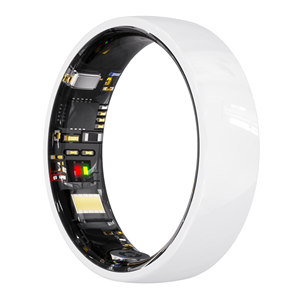
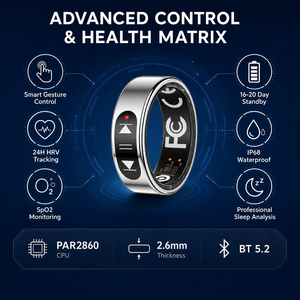
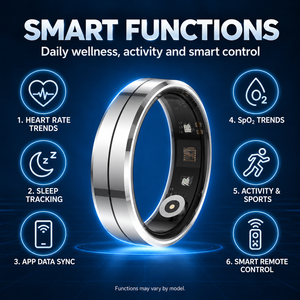
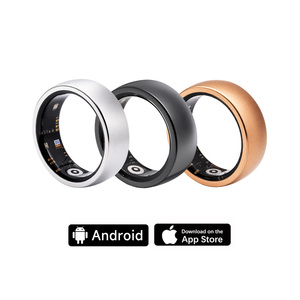
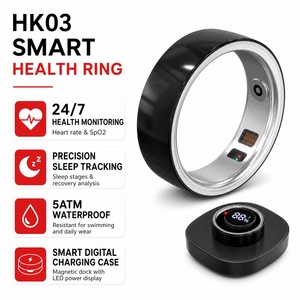
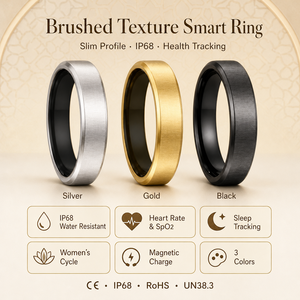
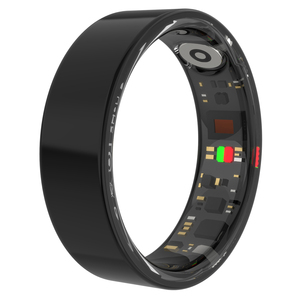
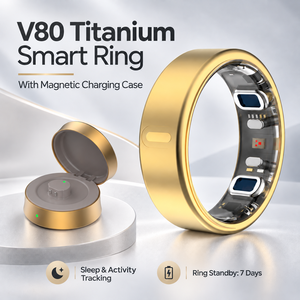
A major procurement trend is cross-device sensor synergy. While AI smart glasses dominate audio capture, contextual vision, and visual HUD alerts, they are ill-suited for continuous physiological monitoring like resting heart rate, sleep staging, and blood oxygen levels due to battery and contact limits. By bundling smart glasses with our ultra-compact ceramic and titanium smart rings (such as the TK8Pro or M08 waterproof series showcased above), brand owners offer customers an integrated 360-degree biometric and spatial-AI ecosystem. The ring handles micro-gesture navigation (swiping slides, accepting calls, triggering voice queries via finger tap) and continuous health telemetry, while the glasses handle ambient audio-visual intelligence.
4. Micro-Optical Evolution: Transition from Geometric Prisms to Diffractive Waveguides
Sourcing programs are shifting from bulky birdbath and prism optics toward geometric and surface-relief grating (SRG) waveguides. Waveguide lenses preserve normal optical transparency (exceeding 85% light transmittance), allowing consumers to wear smart glasses in corporate meetings, dining venues, and urban streets without visual estrangement or social stigma. Waveguide manufacturing requires Class 100 dust-free nano-imprint lithography and automated optical inspection (AOI), core capabilities present in our Shenzhen partner cleanrooms.
8 High-Speed SMT Lines
Equipped with Japanese Yamaha precision mounters, 10-zone reflow ovens, and inline 3D SPI + AOI inspection systems capable of mounting 01005 passive components and 0.3mm pitch BGA micro-controllers with six-sigma repeatability.
ISO9001:2015 Quality System
Stringent IPQC, FQC, and OQC protocols governing electrostatic discharge (ESD) protection, salt-spray corrosion chamber testing, 20,000-cycle temple flex endurance tests, and multi-axis drop reliability verification.
7-Day Rapid Prototyping
In-house industrial design teams, stereolithography (SLA) 3D prototyping, CNC metal milling, and rapid firmware development enable delivery of fully functional pre-production samples within 7 business days from CAD freeze.
Full Export Compliance
Factory-direct compliance testing ensuring seamless CE-RED, FCC ID, RoHS 2.0, REACH, BQB Bluetooth SIG licensing, UN38.3 lithium battery transport certification, and MSDS clearance documentation for hassle-free worldwide logistics.
What is the standard Minimum Order Quantity (MOQ) for custom OEM AI smart glasses?
+
Our standard entry threshold begins at just 200 units per model for private label branding, which covers custom temple laser engraving, bespoke packaging boxes, personalized boot screens, custom Bluetooth pairing broadcast IDs, and customized multilingual instruction manuals. For full custom tooling (new industrial design casing, bespoke frame geometries, customized acoustic cavity molds), our engineering tooling amortization threshold typically begins at 2,000 to 3,000 units.
How does Tucks protect customer Intellectual Property (IP) and proprietary algorithms?
+
We operate under strict bilateral Non-Disclosure Agreements (NDAs) enforceable under both international arbitration frameworks and Chinese judicial jurisdictions. Proprietary firmware source code, industrial CAD files, and AI neural weights are stored on air-gapped secure servers with encrypted role-based permissions. Clients retain full, unencumbered ownership of custom molds, industrial design patents, and software customizations created during the ODM engagement.
Can you integrate third-party Large Language Model (LLM) APIs such as ChatGPT, Claude, or DeepSeek?
+
Yes. Our embedded software engineering team provides comprehensive SDKs and RESTful API bridges for iOS and Android companion applications. We can natively route microphone audio streams directly to OpenAI Realtime Voice APIs, Anthropic Claude, Microsoft Azure Cognitive Services, or open-source edge models running on private cloud infrastructure. Furthermore, we support token-based custom subscription billing integration inside your white-label companion app.
What certifications are provided for export into the North American and European Union markets?
+
All export models manufactured by Tucks are designed to meet or exceed international standards. Standard documentation portfolios include CE (RED directive covering safety, EMC, and radio frequency), FCC Part 15 subpart C/E certification, RoHS 2.0 (Restriction of Hazardous Substances), REACH SVHC declarations, and BQB (Bluetooth Qualification Body) End Product Listing. Optical components also conform to ANSI Z80.3 and EN ISO 12312-1 UV400 sun protection standards.
How do your glasses manage directional audio without high leakage to nearby bystanders?
+
We employ dual-micro-driver dipole acoustic cavities inside each temple. The sound chamber radiates two opposite acoustic waves: a primary acoustic wave focused precisely toward the user's ear canal, and an inverted phase cancellation wave projected outward into 3D free space. This acoustic destructive interference cancels up to 98% of airborne sound wave energy beyond 0.5 meters, guaranteeing speech confidentiality during sensitive corporate or personal phone calls.
What is the typical battery endurance and charging interface architecture?
+
Our audio-only and AI voice glasses incorporate dual lithium-polymer cells (typically 80mAh to 110mAh per temple arm, totaling 160–220mAh), providing 6 to 9 hours of continuous music playback or 4 to 6 hours of active conversational AI engagement, with 7 to 10 days of standby. Camera-equipped models feature dedicated high-rate power management delivering up to 90–120 minutes of active video recording. Charging is executed via proprietary high-speed magnetic pogo-pin cables or an optional molded eyewear charging case with an integrated 1200mAh power bank.
Can smart glasses be fitted with prescription (ophthalmic) lenses?
+
Absolutely. Our frame geometries feature standard front-rim screw fixtures and optical grooves engineered specifically to accommodate standard ophthalmic prescription lenses (single vision, progressive, anti-blue light, and polarized tints). We offer factory-cut prescription assembly or provide standard lens tracing CAD schematics so your local optometric retail network can glaze and edge prescription lenses locally for your end customers.
What thermal management techniques are utilized to prevent temple overheating during camera or AI use?
+
Thermal management is a critical safety and comfort engineering challenge. We utilize ultra-thin pyrolytic graphite heat spreaders (thermal conductivity > 1,500 W/mK) laminated across the inner temple structural ribs, redirecting thermal energy away from sensitive temporal skin contact points toward the outer decorative metallic trim. Additionally, our firmware implements smart dynamic voltage and frequency scaling (DVFS) to throttle processor cycles gracefully before chassis surface temperatures reach 38°C.
What are the lead times for prototyping versus full mass production?
+
For standard catalog base models requiring branding customization (laser logo, custom packaging, localized firmware ROMs, silk-screened frames), functional Golden Samples ship in 7 business days. Following sample sign-off and PO confirmation, mass production runs are fulfilled in 15 to 25 business days. For complete ground-up ODM tooling projects, mold fabrication and pilot T1 trial injections take approximately 35 to 45 calendar days.
How does Tucks manage battery safety and air cargo shipping compliance?
+
All lithium cells undergo severe internal QC including nail penetration, crush resistance, overcharge protection, and thermal exposure testing. Every commercial shipment is delivered with verified UN38.3 test summaries, full Material Safety Data Sheets (MSDS), and drop-test transport packaging certifications conforming to IATA Dangerous Goods Regulations (PI967 Section II) for seamless customs entry through express air couriers (DHL, FedEx, UPS) and global sea freight lines.