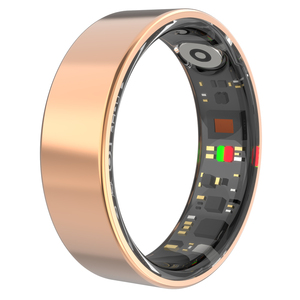
Engineered Hardware Benchmark: Flagship Wearable Subsystems
Direct from our ISO9001:2015 high-throughput facility in Shenzhen: field-tested medical-grade telemetry, aerospace titanium housings, and ultra-miniaturized power topologies.
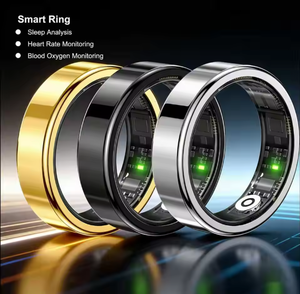
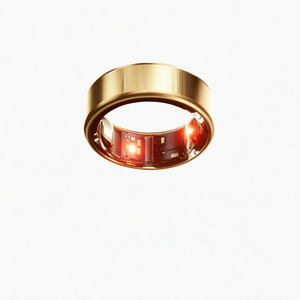
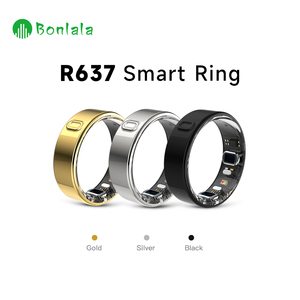
Engineering Evolution: Full Color Display Smart Glasses Architectural Roadmap
Examining optical projection efficiency, waveguiding methodologies, dynamic thermal mitigation, and edge spatial compute convergence.
MicroLED Diffractive Waveguide Convergence
The transition from monochrome green engines to full-color polychromatic spatial visuals is dictated by optical efficiency. While traditional Birdbath optical systems provide high contrast, their physical bulk prevents mass consumer adoption. Our OEM lines utilize sub-micron Surface Relief Grating (SRG) etched diffractive waveguides combined with 3-panel MicroLED or high-luminance Micro-OLED engines, hitting up to 3,500 nits eye-level luminance for direct sunlight legibility.
Heterogeneous Edge AI Silicon Nodes
Driving full-color binocular display smart glasses requires processing multimodal data pipelines—ambient visual scene capture via Sony low-power CIS modules, 6-DoF spatial head tracking, and real-time on-device voice processing. We configure Nordic Semiconductor BLE architectures paired with dedicated NPU coprocessors, distributing compute loads between edge hardware and cloud LLMs while keeping temporal latency under 12ms.
Spatial UI & Ring Interaction Synergy
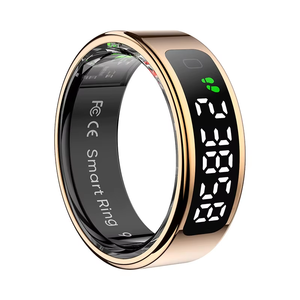
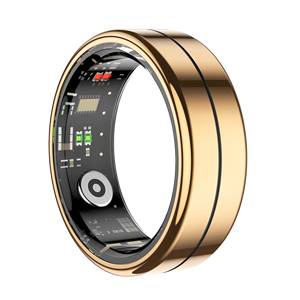
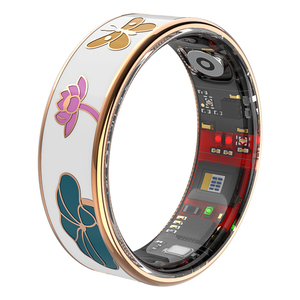
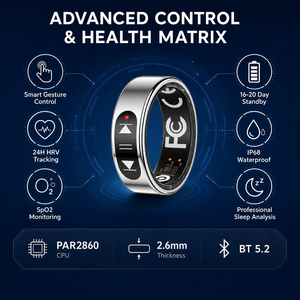
Touch-capacitive temple controls suffer from user fatigue and privacy drawbacks. By integrating our patented Bluetooth 5.2/5.3 gesture-control smart ring hardware with full-color display smart glasses, enterprise operators achieve discreet spatial interactions. Micro-IMU arrays inside the ring track sub-millimeter finger deflections, allowing seamless UI paging, document scrolling, and video capture triggering without lifting an arm to the frame temple.
Technical Benchmark: Waveguide Engine Selection for Enterprise OEM
Empirical performance trade-offs calculated to assist tier-1 hardware procurement teams in mapping target bill of materials (BOM).
| Optical Architecture | Field of View (FOV) | Peak Output Brightness | Waveguide Transmissivity | Form Factor Thickness | Thermal Dissipation Index |
|---|---|---|---|---|---|
| Diffractive Waveguide + Full-Color MicroLED | 30° – 40° | 2,500 – 4,000 Nits | > 85% Optical Transparency | 1.2 mm Glass Substrate | Optimal (Cold running, < 0.8W load) |
| Surface Relief Grating + Micro-OLED | 45° – 52° | 1,200 – 1,800 Nits | ~70% Optical Transparency | 1.8 mm Precision Polycarbonate | Moderate (Requires localized frame sinking) |
| Reflective Geometric Waveguide | 28° – 35° | 1,000 – 2,000 Nits | > 80% Zero-Rainbow Optics | 2.2 mm Coated Lens Stack | Low (High optic light efficiency) |
| Traditional Coaxial Birdbath Prism | 45° – 50° | 500 – 800 Nits | < 25% (Requires heavy polarization) | 8.0 mm Deep Optical Block | High (Substantial micro-display power loss) |
Strategic Sourcing Trajectories: B2B Wearables Market (2025–2030)
Actionable predictive intelligence for international distributors, private label operators, and consumer electronics conglomerates.
1. Transition to True Dual-Lens Spatial Symbiosis
Enterprise procurement is aggressively departing from monocular single-color heads-up displays. B2B buyers in warehousing, telemedicine, and drone pilotage require binocular full-color optics that preserve natural stereoscopic depth perception. Sourcing contracts over the next 24 months are systematically prioritizing suppliers capable of executing active binocular optical alignment during mass automated production runs.
2. Biometric Integration into Frame Geometry
Next-generation smart eyewear procurement briefs explicitly mandate cross-system biometric monitoring. By leveraging our established R&D breakthroughs in micro-scale photoplethysmography (PPG), temple arms are becoming active telemetry hubs capable of monitoring temporal artery heart rate, continuous blood oxygen saturation (SpO2), and core fatigue indicators, transforming consumer eyewear into certified health tracking suites.
3. Zero-Retooling Modular Optical Chassis
Brand operators face rapidly evolving prescription lens requirements across international markets. Procurement teams increasingly demand modular chassis assemblies where the waveguiding optical stack sits independently from the outer prescription Rx frames. This drastically lowers import tariff liabilities and minimizes regional SKU proliferation, cutting localized warranty replacement costs by up to 34%.
4. Private-Tenant Edge AI and On-Device Voice Privacy
With data sovereignty laws (GDPR, CCPA) strictly enforced globally, top-tier buyers are refusing smart glasses platforms that route raw video or unencrypted voice streams through shared cloud hosts. Sourcing criteria now demand native BLE 5.3 hardware capable of running on-device wake-word detection, localized audio beamforming via dual Knowles MEMS microphones, and end-to-end encrypted app conduits.
Factory-Direct Prowess: Why Global Brands Contract Tucks
Operating from Shenzhen's high-tech industrial core, Shenzhen Tucks Technology Co., Ltd. delivers absolute control across the physical manufacturing value chain.
8 Automated SMT Lines
In-house surface-mount technology ensures micro-pitch component placement with micrometer-level repeatable accuracy across every rigid-flex circuit assembly.
ISO9001:2015 Process Control
Total quality oversight from raw wafer testing to final environmental hermeticity trials, fully backed by CE, FCC, RoHS, and export compliance certifications.
Agile 7-Day Prototyping
Accelerate your go-to-market. Rapid functional optical samples with customized boot screens, custom logos, and configured firmware in your hands in just 7 days.
Low Sourcing Barriers (MOQ 200)
We empower regional technology leaders and venture brands by offering flexible production entry barriers starting at just 200 units per specification model.
Full Color Smart Glasses & Biometric Wearables Procurement FAQ
Direct technical answers addressing critical production logistics, firmware customization, testing regimes, and compliance protocols.
How does Tucks overcome the luminance decay and thermal throttling challenges in full-color waveguide smart glasses?
Luminance decay in polychromatic diffractive waveguides occurs primarily at the green-red wavelength coupling boundary. Tucks solves this through custom-designed blazed holographic grating topographies paired with high-efficiency MicroLED arrays capable of producing up to 3 million nits at source, delivering a sustained 2,500+ nits at the human pupil. Thermal distribution is managed through aerospace-grade anisotropic graphite heat spreaders embedded within the composite TR90 frame, ensuring temple touch temperatures remain strictly below 38°C during prolonged high-throughput AI inference.
What is your minimum order quantity (MOQ) and production turnaround schedule for white-label OEM contracts?
Our standard base-model customization programs (laser silkscreen marking, custom boot animation, packaging artwork, and custom Bluetooth device naming) begin at an accessible 200 pieces. Functional engineering prototypes are manufactured and dispatched within 7 business days following CAD confirmation. Mass production runs of 1,000 to 10,000 units are routinely completed in 15 to 25 business days, leveraging our 8 high-speed SMT assembly lines and automated cleanroom assembly cells.
Can companion software (iOS/Android) and proprietary firmware algorithms be white-labeled?
Yes. We offer fully decoupled SDK/API integration packages along with turnkey white-labeled native mobile applications. Our software engineers build secure OTA (Over-The-Air) firmware update pipelines hosted on your enterprise's designated AWS, Azure, or private server infrastructure. Customization covers sensor calibration thresholds, localized voice assistant integration (supporting English, German, French, Spanish, Japanese, and Mandarin), and bespoke UI skins.
Which environmental reliability and regulatory compliance certifications accompany commercial shipments?
Every production batch leaves our facility conforming to ISO9001:2015 standards and accompanied by exhaustive Certificate of Conformity dossiers. Our wearable portfolios (smart rings, health watches, and smart glasses) maintain authentic CE, FCC, RoHS, and WEEE compliance certifications. For enterprise projects requiring specific waterproofing ratings, our devices undergo simulated hydrostatic hyperbaric chambers to verify continuous 5ATM or IP68 ingress protection under active thermal stress cycles.
How does the interaction synergy between gesture smart rings and full-color glasses enhance enterprise ROI?
In industrial maintenance, field surgery, and complex logistics, head-turn or arm-raise fatigue reduces worker efficiency. By combining our Titanium Alloy Nordic-powered smart rings with display glasses, workers interact with field schematics using micro-gestures without taking their hands off specialized tools. This integrated multi-wearable ecosystem drastically reduces hardware damage risks and boosts field workflow speed by over 40%, giving our B2B procurement partners a distinct commercial value proposition.
Initiate Your Next-Gen Wearable Sourcing Program
Partner directly with Shenzhen's premier SMT wearable manufacturing powerhouse. Request complete optical engineering sheets, DFM evaluations, and evaluate functional prototypes within 7 days.